

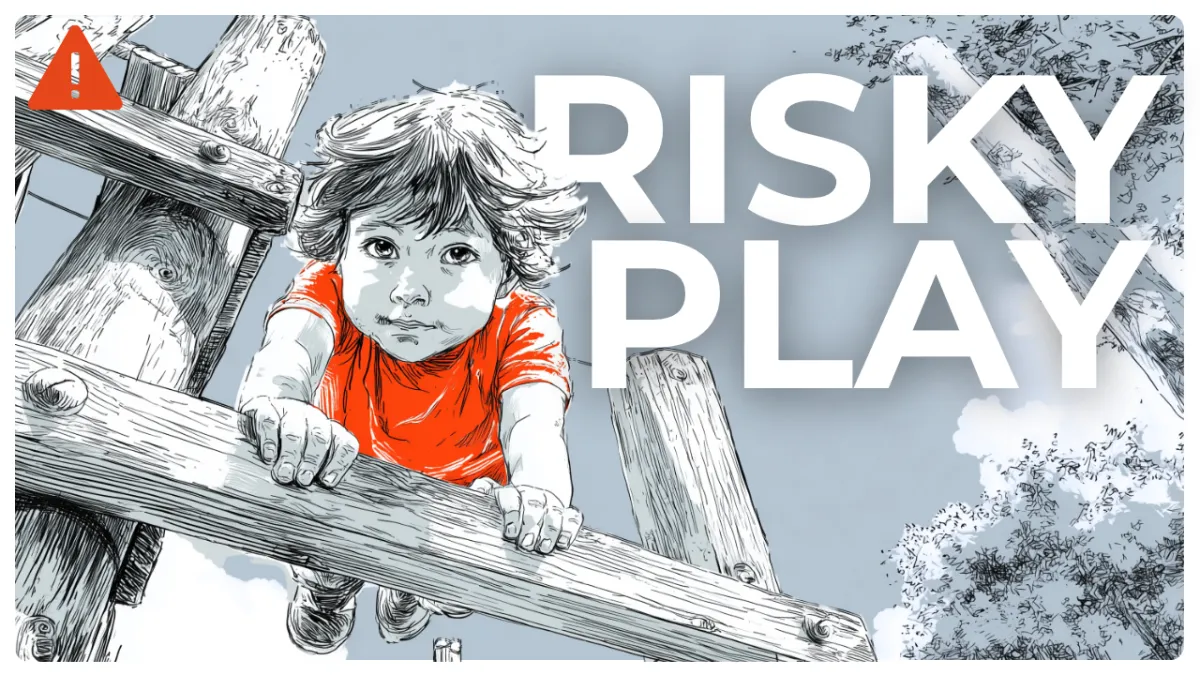
The "Dangerous" Playground That's Actually Safer Than Yours
The "Dangerous" Playground That's Actually Safer Than Yours
Why risky play and outdoor education matter more than we admit, and what to say when someone tells you that you are being irresponsible.
A few weeks ago, a video went viral of a mom standing in a playground in Melbourne, Australia, asking what is essentially the question of our parenting era: "What is this, and who let my toddler near it?"
I understand the reaction. The place looks unhinged. Giant bluestone boulders sit on what appear to be furniture dollies. Twisted metal pokes out of the rocks. Slides look propped up by a rope and a prayer. It is called "Rocks on Wheels," and your gut says the same thing hers did. No way. Not my kid.
So here is the part that should stop you.
That playground is engineered to be safer than the standard plastic playground down your street.

It only looks dangerous
The boulders that look like they could roll off the dollies are anchored with hidden steel rods. They are not going anywhere. The ground that looks like hard stone is actually rubber flooring made to mimic bluestone, so when a child falls, and children fall, they land on something soft. Even the bits of metal and pipe that look like leftover construction junk are deliberately placed and anchored so nothing can catch a finger or a sleeve. They are not an oversight. They are part of how the playground passed its safety inspection.
The designer, New Zealand engineer and artist Mike Hewson, says the quiet part out loud. He builds these spaces to feel precarious while being as solid, or more solid, than the safe-looking equipment we are used to.
Sit with that irony for a second. The thing we recoil from is the appearance of risk. The actual danger has been engineered out. What we are reacting to is a feeling. And that flinch is the whole problem.
The difference between a risk and a hazard
This is the single most important idea here, and if you advocate for kids, it is the line to memorize.
A hazard is a danger a child cannot see and cannot assess. A rusty nail. A broken latch. A blind spot near a road. Hazards are bad. We remove them. Full stop.
A risk is a challenge a child can see, can weigh, and can choose to take on. A high climb. A wobbly log. A jump that is a little too far. The child looks at it, feels the flutter of fear, and decides.
Good play design does not remove risk. It removes hazards and keeps risk. That Melbourne playground is the perfect example. They took out everything a child could not assess and left in everything a child gets to test themselves against.
I grew up with metal slides that would scorch the back of your legs in the summer. And you know what we learned? To put one hand down first and test it before committing. That was not a design flaw. That was a child running a real-time risk assessment and learning that the world gives feedback. We did not need to ban the slide. We needed kids to learn how to read it. We have spent thirty years sanding those lessons out of childhood and calling it responsibility.

Risky play is exposure therapy
Here is where it stops being nostalgia and becomes developmental science.
Researcher Ellen Beate Hansen Sandseter, with Leif Kennair, describes what they call the anti-phobic effect of risky play, and it rests on something called non-associative fear theory. Children come pre-loaded in early childhood with a set of natural fears: heights, deep water, strangers, separation from a caregiver. Those fears are protective. They keep a one-year-old who cannot yet climb safely from walking off a ledge.
But those fears are meant to be temporary. They are supposed to fade at exactly the age when the child becomes physically capable of handling the thing. And the mechanism that fades them is risky play. The child seeks out the very thing they used to fear, in a dose they choose, and every time they come out the other side fine, the fear gets quieter.
If that sounds familiar, it should. It is exposure therapy, the precise technique a clinical psychologist uses to treat an adult phobia. Risky play is childhood running that protocol naturally, on its own schedule, for free, years before anyone would need a therapist. And the unsettling flip side is this: if a child never gets the exposure, the fear does not reliably fade. It can follow them into adulthood.
Watch how kids actually do this and the behavior gives it away. A child learning a scary jump does it over and over, the same jump fifty times in an afternoon. That repetition is the dosing. And they are not doing it to get good at risk assessment. They are doing it for the thrill. The competence is a byproduct. Nature wrapped the medicine in candy.
Sandseter sorted this play into roughly six categories: great heights, high speed, dangerous tools, dangerous elements like water and fire, rough-and-tumble, and the one we have nearly eliminated entirely, roaming and exploring out of an adult's direct line of sight. Each one is a small, self-dosed exposure trial. And this is not a Western fad. Researchers find risky play across cultures worldwide. What is unique to wealthy Western societies is the steep climb in adult risk-averseness over recent decades.
When the largest systematic review of risky outdoor play, led by Canadian researcher Mariana Brussoni, pulled the evidence together, it found that more risky play is linked to more physical activity, better social health, and stronger self-regulation, and that keeping kids from it does not deliver the safety payoff we imagine. The catastrophic injuries we fear are rare. The everyday ones are real but overwhelmingly minor. The scrapes that are, frankly, part of the curriculum.
I want to be honest about the limits, because credibility matters. The strongest claim, that low-risk childhoods directly cause anxious adults, is still a leading hypothesis, not a closed case. Much of the evidence is theoretical or correlational. But the mechanism is well supported, and there is a respected model from Helen Dodd and Kathryn Lester laying out how adventurous play protects kids from anxiety. So here is the honest, unbeatable version of the argument: the research strongly suggests that when we strip risk out of childhood, we remove one of the natural tools kids use to keep their own anxiety in check.

We cut risk from both ends of childhood
Here is the part almost nobody connects.
We bubble-wrap kids on the playground when they are small. Then they become teenagers, right at the age when risk is supposed to graduate into bigger things, independence, navigation, judgment, and we have spent years gutting the exact programs that teach it. Outdoor education. Experiential education. The overnight trips and the days in the bush with a trusted adult and a managed challenge.
In Ontario, we watched the Toronto District School Board close five outdoor education centres. These programs are treated as the first thing to cut and the last thing to fund. And they were the places where a fifteen-year-old got to do the teenage version of the metal slide: feel the fear, assess it, take it on, succeed, and walk away a more capable human being.
We took the risk out of the beginning of childhood, and out of the end of it too. We cut it at both ends. And then we are surprised that we have a generation of young adults who were never once allowed to practice being brave in a place where it was safe to try.
For the educators and the advocates
If you are the teacher who wants to take the class outside and meets a wall of nervous parents, or the outdoor educator fighting for a program, here is your toolkit.
When a parent says, "what if my kid gets hurt," do not get defensive. Say: "Our job is to remove every hazard, the dangers they cannot see, and then keep the risks they can, because that is exactly how children learn to keep themselves safe."
When someone says a challenging environment gives kids "false confidence," say: "It is the opposite. Real confidence is built on real experience. False confidence is what you get when a kid has been told the world is safe and never allowed to test it."
When someone calls you irresponsible, say: "The research is clear that the harm of removing risk is now larger than the risk of the mostly minor injuries we are trying to prevent."
You are not arguing for recklessness. You are arguing for managed risk, hazards removed, with a trusted adult nearby. That is the most pro-child position in the room, and you get to say so.
Want it on one page? I made a free one-page guide you can hand straight to a parent or a principal. The science and the talking points, all on a single sheet.

DOWNLOAD THE ADVOCATE'S ONE-PAGE GUIDE
Find your people. The ReWild Community is a free space for the folks who believe kids belong outside. Join at projectrewild.com/join
I love you, be excellent to each other, and I'll see you outside.
P.S If you haven't already, check out the video we made about the Rocks on Wheels Playground.
