

The Kids Weren't Allowed Off the Sidewalk
The Kids Weren't Allowed Off the Sidewalk:
What Ontario's Tick Panic Is Costing Our Children — and What to Teach Instead
A colleague of mine is an outdoor educator. A few weeks ago, she hosted a school field trip to a beautiful Ontario green space — trails, meadow, forest edge, a full day of programming she'd spent days preparing. The children experienced none of it. The classroom teachers accompanying the group refused to let the students step off the sidewalk. Not the trail. Not the grass. The sidewalk.
The reason was ticks. And the bitter irony is that my colleague had anticipated exactly this anxiety. She had built tick safety directly into the day's lesson: how to dress, where ticks actually live, how to do a proper tick check. Those children were going to leave that field trip measurably safer than they arrived — equipped not just for one outing but for every outdoor day of their lives. Instead, they learned a different lesson entirely: that grass is dangerous and adults are afraid of it.
I want to be fair to those teachers, because their fear didn't come from nowhere. Blacklegged ticks — the species that can transmit Lyme disease — are expanding their range across Ontario at an estimated 35 to 55 kilometres northward per decade, driven by warming winters that no longer kill them off. Established populations now exist in the Toronto ravines, High Park, Rouge National Urban Park, and along the escarpment. Lyme disease case counts in Canada have risen roughly tenfold over the past decade, and Ontario carries a large share of them. A parent or teacher who feels uneasy about tick season is not being irrational. They're reading the headlines correctly.
The problem is what they're doing with that fear.
The response to a genuine risk is risk management, not risk avoidance. We do not respond to traffic fatalities by forbidding children from ever crossing a street; we teach them to look both ways. We do not respond to drowning statistics by banning water; we enroll them in swimming lessons. Our entire educational tradition is built on meeting danger with competence — road safety, water safety, fire safety. Somehow, when the hazard lives in the grass, that tradition collapses into a sidewalk.
And ticks are arguably one of the most manageable hazards in the entire outdoors, because of a single biological fact: in most cases, a blacklegged tick must remain attached for roughly 24 hours or longer before Lyme disease transmission becomes likely. That window changes everything. It means a five-minute tick check at bath time — a simple daily ritual — eliminates the overwhelming majority of the risk. This is not a lightning strike. It is a hazard with a built-in grace period and a free, teachable, child-friendly countermeasure.
The sidewalk, meanwhile, protects no one. Those same children walk past ravines on the way home from school. They play in backyards bordering wood lots and visit cottages on long weekends. Ticks do not honour a school board's risk assessment. The children will encounter tick habitat regardless; the only open question is whether they'll have skills when they do. And the cost of fencing kids off from nature is well documented across this site — diminished attention restoration, lost nervous-system regulation, weakened risk competence, and the slow construction of a generation that believes the outdoors is a threat to be managed from behind glass.
So here is what I wish every Ontario teacher and parent knew — the lesson that never happened on that sidewalk.
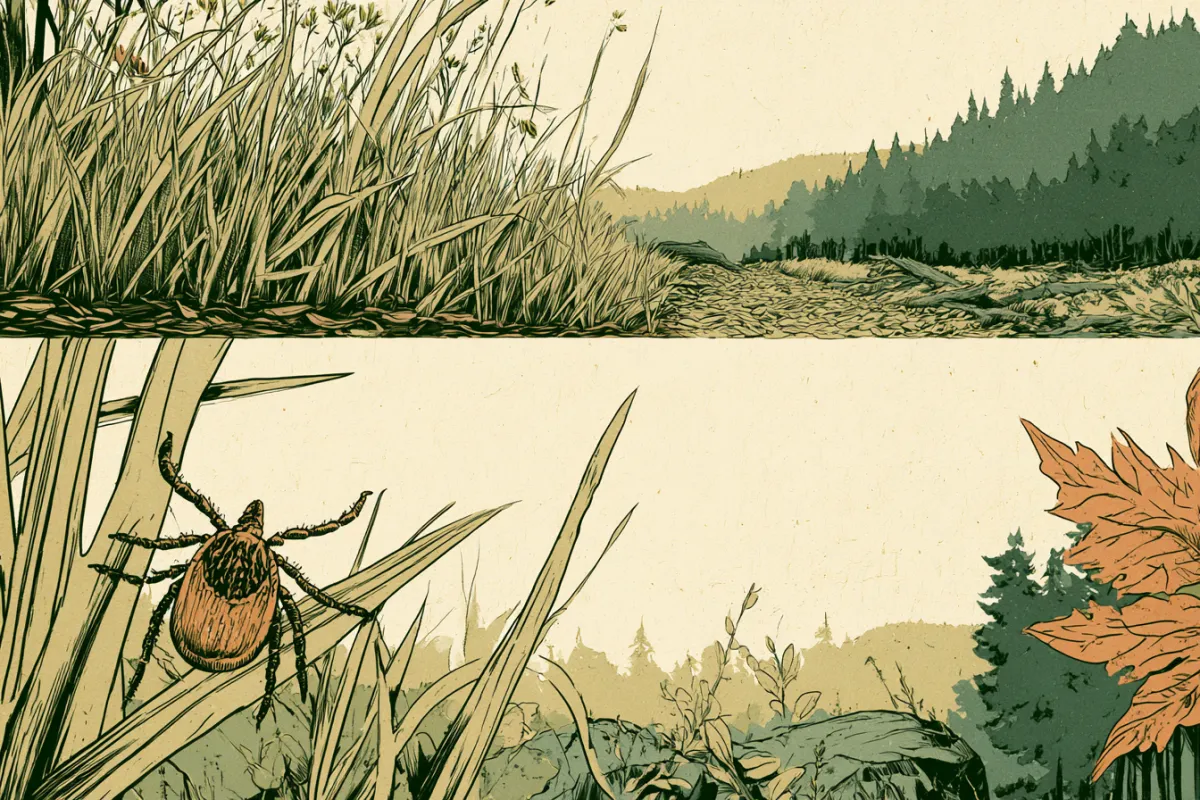
Know where ticks live. Ticks don't jump, fly, or drop from trees. They climb to the tips of tall grass and shrubs and wait, front legs extended, for something to brush past — a behaviour called questing. They favour tall grass, leaf litter, brushy forest edges, and shady damp ground. They are scarce on short mowed grass in full sun, gravel, and pavement. Teach children to read the landscape — to identify "tick hotels" (leaf litter, long grass, log piles, shady edges) versus "tick deserts" (sunny mowed fields). A child who can read habitat isn't banned from nature; she's literate in it. It also reframes the original scene: the mowed field that class was avoiding was likely among the lowest-risk green spaces available to them.
Dress like a field biologist. Light-coloured clothing so a poppy-seed-sized tick is visible. Long sleeves and pants, with pants tucked into socks. Yes, it looks silly — so make it a badge of honour rather than an act of fear. Closed shoes, hair tied back, hat on.
Use the Canadian repellent rules, not the American ones. For children six months to twelve years, the Public Health Agency of Canada identifies icaridin (up to 20%) as the preferred repellent. DEET may be used on children only at low concentrations, around 10% or less. Apply repellent to exposed skin only, never under clothing or on children's hands. And note a detail most Canadian parents have never heard: permethrin-treated clothing, a staple of American tick advice, is approved in Canada only for ages sixteen and up. If a blog tells you to dress your second-grader in permethrin-treated pants, it is not giving you Canadian guidance.
Make the tick check a ritual, not a panic. After outdoor play, check within a couple of hours and shower if possible. Run outdoor clothes through the dryer on high heat for about ten minutes — heat kills ticks reliably. The check itself follows the tick's logic: they crawl upward seeking warm, hidden skin. Scan the hairline and scalp, behind the ears, the neck, armpits, belly button, waistband, groin, behind the knees, and between the toes. Turn it into a song or a head-to-toe dance for young children, pair students for buddy checks of backs and hairlines, and let a lint roller over clothing reveal any hitchhikers. A child who learns the tick check as a game at seven performs it automatically at seventeen.
If you find one, stay calm — this is a tweezers job, not an emergency. Using fine-tipped tweezers, grasp the tick as close to the skin as possible and pull straight upward with slow, steady pressure. Do not twist, burn, or smother it with petroleum jelly or nail polish; those folk remedies can cause the tick to regurgitate into the bite. Clean the area with soap and water. Photograph the tick and submit the image free of charge to eTick.ca, where experts will identify the species, typically within a day. Mark the date, and watch for symptoms over the following month — particularly an expanding rash or fever. If symptoms appear, see a doctor and mention the bite. Identified early, Lyme disease is treatable with antibiotics.
That is the entire protocol. Notice what it is not: it is not a sidewalk.
To the teachers standing on that pavement — I believe your fear came from love. But the children in your care deserved more than your anxiety; they deserved your competence. The safest child is not the one who never touches grass. The safest child is the one who knows how to dress, where ticks live, how to check, and what to do when she finds one. That child is safe on the field trip, in the backyard, at the cottage — for life.
You cannot ban your way to that child. You can only teach your way there.
I love you, be excellent to each other, and I'll see you outside.
